• Skip to content
  • Skip to primary sidebar

Header Right

  • Home
  • About
  • Contact

Taxes

Are You Tracking Absolutely All of Your Tax-Related Business Expenses?

January 18, 2022 by Admin

If you’re self-employed, understanding what’s deductible and recording all of your business expenses should be priorities.

When you work for yourself, accurate accounting is critical. The IRS pays special attention to tax returns prepared by sole proprietors. Not only does the agency try to determine whether all taxable income has been recorded, but they also scrutinize business expenses that are claimed, since some taxpayers blur the lines between personal and business purchases.

We’re not suggesting you hold anything back when you’re tracking your tax-deductible business expenses. We want you to claim every penny that the IRS says is permissible. This is especially important if your company makes a lot of money. You’ll need to document everything you can to offset your income and minimize your tax obligation.

How do you ensure that all of the money you’re spending to make money ends up somewhere on your IRS Schedule C? Let’s look at steps you can take.

Review the Schedule C
tax tips

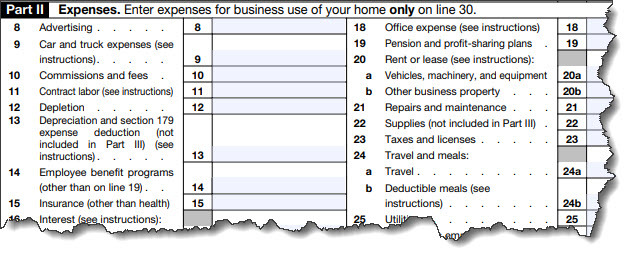
The actual IRS Schedule C form contains broad expense categories. You may need to dig into deeper explanations of them.

If you’ve never completed a Schedule C before, it’s especially important that you familiarize yourself with it. You can view a copy of the 2020 version here. Pay special attention to Part II Expenses. The form breaks down business expenses into specific categories. But what’s the difference between Office expenses and Supplies? What does Other business property mean? Not only do you have to know which expenses are deductible, but you must be sure to include them in the right category.

The IRS has a special publication devoted to discussion of deductible business expenses. You’ll find links to it here. It’s a lengthy document, but there’s an interactive table of contents that lets you jump right to the section you want. You don’t have to read the whole thing, but you might bookmark it so you can consult it when you have a question. There are many questions on the Schedule C that may require additional explanation.

You might want to visit the IRS instructions online. This page displays a detailed outline of the form, section by section and line by line, so you can find what you’re looking for easily and click a link to get there.

Keep Detailed Records

This will be challenging if you’re doing your bookkeeping manually. You’ll need to set up a system of folders or envelopes or whatever works for you and separate receipts by either month or Schedule C category. If you know your way around Excel, you could set up a spreadsheet divided by category and enter receipt information as it comes in. This will make calculations easier, too.

Do make notes on your receipts so you’ll know why you thought the purchases would be deductible. You might also indicate whether the receipt was already entered in your master list, so you don’t have duplicate entries. Don’t forget about credit card charges and checks you’ve written for tax-deductible purchases that didn’t generate a receipt. Enter them in your master list as you go. If you’re ever audited, you’ll need copies of them for documentation. If you get electronic receipts in email, save them in a folder on your computer and record them.

tax tips

You can categorize your tax-related business expenses using personal finance or accounting applications.

There are numerous personal finance and small business accounting applications that allow you to import your online banking transactions and categorize them. These include QuickBooks (online and desktop), Mint, Quicken, and Simplifi by Quicken. Their category lists can often be modified, so you can make sure your tax-related expenses are organized accurately.

Don’t Dismiss the Unusual

There are some legitimate tax deductions that the IRS doesn’t necessarily include in the Schedule C instructions, but which it will accept. For example, H&R Block reported on a case where the cost of cat food was considered a business deduction (a scrapyard was trying to attract wild cats to keep snakes away). A professional bodybuilder was able to claim his purchase of ProTan Muscle Juice Professional Posing Oil as an acceptable business expense.

We’re not recommending that you spend a great deal of time looking for obscure tax deductions. But think about your purchases as you make them to see if they’re tax-worthy.

All of these suggestions may sound time-consuming. They can be, until you get into the habit of tracking all of your tax-related business expenses, but it does require constant diligence. We can help ensure that you’re only claiming legitimate deductions and advise you on those you might question. We can also prepare and file your return for you and/or help with year-round tax planning. Contact us for a consultation.

Filed Under: Taxes

7 Small Business Tax Credits You Should Know About for 2021

August 23, 2021 by Admin

Notebook with tax credit  sign on a table. Business concept.Small businesses benefit from various tax credits that reduce the amount of tax they pay to the government. Here, we discuss tax credits, why they exist and provide a list of the top tax credits that small business owners should know.

Small Business Tax Credits

A small business tax credit is an amount of money subtracted from the taxes the business owes. Tax credits differ from tax deductions. For example, deductions cut a business’ total tax by a percentage of the deduction, depending on the tax bracket. Alternatively, tax credits reduce the tax due, not the amount of taxable income. In other words, a small business tax credit is a dollar for dollar deal – every dollar of credit cuts the business’ tax by a whole dollar. This credit is a significant benefit for small business owners because it helps recover some operating costs and retains the precious capital needed for growth.

As a practical example, if your business owes $20,000 in taxes, but you can claim a $5,000 tax credit, that amount is subtracted from your total tax bill making the new tax bill $15,000.

The Purpose of Small Business Tax Credits

The U.S. government grants tax credits to promote behaviors it finds favorable. For example, tax credits are offered to businesses as incentives for activities that benefit employees, promote specific industries, or aid or benefit society. One example is the government offering tax credits to businesses that purchase electric vehicles. The government encourages this to fight climate change and global warming. Because tax credits can have such a dramatic impact on a small business’s bottom line, it is crucial to stay apprised of tax credits for which your business is eligible.

7 Small Business Tax Credits for 2021

In the wake of the COVID-19 pandemic, related tax credits for small businesses top the list.

1. Employee Retention Credit

Under the American Rescue Plan, the Employee Retention Credit (ERC) is extended for small businesses through December 2021 and is available for all four quarters of the year. This tax credit allows small businesses to offset payroll tax liabilities by up to $7,000 per employee per quarter. That means a credit of up to $28,000 per employee is available for small businesses whose revenue declined due to the COVID-19 pandemic. A 20 percent decline in gross receipts during a single quarter makes a business eligible for this tax credit.

2. Paid Leave Credit

Another tax credit that falls under the American Rescue Plan is the Paid Leave Credit. This credit is extended through September 30, 2021, and offers credits for small and midsize businesses that offer paid leave to employees for COVID-related illness, quarantine, or family caregiving. The allowable credit is equal to wages up to $5,000 of paid leave for sick or quarantining employees.

Note: Small businesses are no longer required by law to offer paid leave related to COVID; however, if they do, the credit still applies.

Other tax credits of which small businesses should be aware are:

3. Health Care Tax Credit

With the Health Care Tax Credit, the smaller the business, the bigger the credit. The credit is highest for businesses with fewer than ten employees. Generally, the way to qualify for the credit is by enrolling in a Small Business Health Options Program (SHOP).

A business must meet the following requirements to qualify:

  • (a) have fewer than 25 full-time employees,
  • (b) have an average employee salary of approximately $50,000 per year or less,
  • (c) pay at least 50 percent of full-time employees’ healthcare premiums, and
  • (d) offer SHOP coverage to all full-time employees.

This credit can be claimed for two consecutive years, applicable from 2017 forward.

4. Work Opportunity Credit

This credit is available to employers who hire from specific groups that face barriers to employment. For example:

  • Qualified IV-A Recipient – receiving TANF assistance
  • Qualified Veteran – the IRS provides details of what “qualified” entails on their site under Tax Credits
  • Ex-Felon
  • Designated Community Resident (DCR) – between 18 and 40 years old and living in an empowerment zone, an enterprise community, or a renewal community
  • Vocational Rehabilitation Referral – a person who has a physical or mental disability and has been referred to the employer while receiving or upon completion of rehabilitative services
  • Summer Youth Employee
  • Supplemental Nutrition Assistance Program (SNAP) Recipient
  • Supplemental Security Income (SSI) Recipient
  • Long-Term Family Assistance Recipient
  • Qualified Long-Term Unemployment Recipient

Under the Consolidated Appropriation Act, 2021, this credit was extended until December 31, 2025.

5. Disabled Access Credit

Eligible small businesses that earn $1 million or less and have a maximum of 30 full-time employees in a year can claim this credit each year in which expenditures are incurred to make their business accessible to persons with disabilities under the Americans with Disabilities Act (ADA).

Expenditures include, but are not limited to, installing wheelchair ramps, upgrading restrooms, and providing Braille text materials.

6. Employer-Provided Childcare Facilities and Services

While few businesses these days seem to provide in-house child care for their employees’ children, a tax credit can make this an attractive option. This credit is a general business tax credit for 25 percent of qualified employer-provided child care expenditures plus 10 percent of qualified child care resources and referral expenditures. The credit is capped at $150,000 per tax year.

Qualifying expenditures:

  • Include operating costs of a qualified child care facility
  • Include costs for acquisition, construction, rehabilitation, or expansion of a property used as a care facility (but not land or any part of the principal residence of the taxpayer)
  • May not exceed the fair market value of care provided

The employer-run facility must open enrollment to employees and must not discriminate in favor of highly compensated employees. At least 30 percent of the facility’s enrollment must consist of dependents of taxpayer employees.

7. Research and Development (R&D) Tax Credits

Several R&D tax credits exist for small businesses. These credits typically apply to science, medical and technology-based businesses; however, many businesses engage in qualified R&D activity.

The following activities qualify for an R&D tax credit:

  • New prototype or model development
  • Proprietary product on which you seek a patent
  • Developing a new manufacturing process or business process
  • Improving product efficiency or existing business processes
  • Improving quality control processes
  • Environmental or certification testing

Businesses that qualify for this credit can subtract up to 10 percent of R&D costs from their tax bill.


Ask your tax professional about small business tax credits that apply to your business. There are additional federal small-business tax credits from state and local governments. Tax credits often expire after a few years, so act quickly to take advantage of those that apply to you.

We offer a variety of tax planning services to both businesses and individuals. Conscientious tax planning throughout the year can save you money and make tax time easier. Call us at 702-658-9535 and request a free initial consultation to learn more.

Filed Under: Business Owners, Small Business, Taxes

The Top 5 Ways Businesses Get in Trouble With the IRS

July 19, 2021 by Admin

Investor working new startup project.As a small business owner, you probably know that willfully avoiding paying taxes will lead to severe problems with the IRS; however, IRS problems aren’t always a result of a business owner’s intentional actions. These are five ways business owners can get into trouble with the IRS that they might overlook or not realize.

1. Under-Reporting Income

All business income must be reported to the IRS. Even if you are a freelancer, receive contract payments, or are paid in cash, you must let the IRS know or risk hefty fines and penalties on top of the tax you owe on that income. Some individual self-employed people fail to pay taxes – either due to lack of knowledge about tax laws or evasion – and do not realize they are responsible for up to six years of back tax returns. Take note that if you do need to file back tax returns, many deductions are not claimable on more than the most recent three returns. Additional years, up to six, must be filed; however, the benefit of deductions is lost beyond three years.

2. Over-Reporting Expenses

Keep business expenses separate, preferably paid from a separate account and with a separate credit card, so that your expenses do not get mixed in with those for your business. The most common over-reported expenses are private travel being claimed and business travel and private miles driven and claimed as business miles. If you’re not sure what qualifies as an actual business expense, consult with your tax preparer or accountant. For a business expense to be deductible, it must be ordinary and necessary. An “ordinary” expense is common and accepted in your business; a “necessary” expense is helpful and appropriate for your business. Expenses like the cost of goods sold (for manufacturing businesses) and capital expenses (costs that are part of your investment in your business) are figured separately from business expenses.

3. Failing to Report “Trust Fund Taxes”

As an employer, you must withhold taxes from employee earnings. Those taxes are not paid to employees as wages and are held “in trust” until paid to the U.S. Treasury. Thus, the name “trust fund taxes.” These are income tax, Social Security, and Medicare taxes (aka “withholdings”). Sales tax is also considered a “trust fund” tax since it is collected from someone else like a customer or client and held until paid to the Treasury. These taxes must be paid and reported to the proper taxing authority and cannot be used for operating or financing a business. If they are, and they are not reported, it is considered tax fraud.

4. Forgetting the Self-Employment Tax

Just like an employer must withhold Social Security and Medicare taxes from employees, if you are self-employed, you must pay self-employment (SE) tax, consisting of Social Security and Medicare taxes, to the Treasury. The SE tax is 15.3 percent (12.4 percent for social security (old-age, survivors, and disability insurance) and 2.9 percent for Medicare (hospital insurance) of net self-employment income in addition to income taxes. That means it is calculated after expenses are deducted. Note that SE tax does not include any other taxes that self-employed individuals may be required to file, so these individuals must consult their tax preparer or accountant to be sure they are paying all the required taxes. Also, self-employed individuals can deduct the employer-equivalent portion of the SE tax when calculating their adjusted gross income (AGI). Also, keep in mind that the tax is paid only on net self-employment earnings, that is, income after expenses are deducted.

5. Not Paying Estimated Quarterly Taxes

As a small business owner, you do not have taxes withheld from a formal paycheck as wage-earning employees do. However, that does not mean there are no taxes due to the IRS. If a small business owner anticipates a tax liability of $1,000 or more, they must send estimated quarterly tax payments to the IRS. Not doing so can lead to a whopping end-of-year tax bill with penalties, too.


Again, as mentioned above, consult your tax preparer or trusted accountant to help you make sure you stay in the clear with the IRS.

The IRS doesn’t make solving tax problems easy for taxpayers. Dealing with the IRS is stressful and extremely confusing for the average person. Stop trying to resolve these complex issues on your own and call J W Enterprises, LLC at 702-658-9535 now or request a free initial consultation online.

Filed Under: Taxes

“Extender” Legislation Impacts Individuals and Small Businesses

January 19, 2021 by Admin

side profile of a businesswoman using a laptopThe federal spending package that was enacted in the waning days of 2019 contains numerous provisions that will impact both businesses and individuals. In addition to repealing three health care taxes and making changes to retirement plan rules, the legislation extends several expired tax provisions. Here is an overview of several of the more important provisions in the Taxpayer Certainty and Disaster Relief Act of 2019.

Deduction for Mortgage Insurance Premiums

Before the Act, mortgage insurance premiums paid or accrued before January 1, 2018, were potentially deductible as qualified residence interest, subject to a phase-out based on the taxpayer’s adjusted gross income (AGI). The Act retroactively extends this treatment through 2020.

Reduction in Medical Expense Deduction Floor

For 2017 and 2018, taxpayers were able to claim an itemized deduction for unreimbursed medical expenses to the extent that such expenses were greater than 7.5% of AGI. The AGI threshold was scheduled to increase to 10% of AGI for 2019 and later tax years. Under the Act, the 7.5% of AGI threshold is extended through 2020.

Qualified Tuition and Related Expenses Deduction

The above-the-line deduction for qualified tuition and related expenses for higher education, which expired at the end of 2017, has been extended through 2020. The deduction is capped at $4,000 for a taxpayer whose modified AGI does not exceed $65,000 ($130,000 for those filing jointly) or $2,000 for a taxpayer whose modified AGI is not greater than $80,000 ($160,000 for joint filers). The deduction is not allowed with modified AGI of more than $80,000 ($160,000 if you are a joint filer).

Credit for Energy-Efficient Home Improvements

The 10% credit for certain qualified energy improvements (windows, doors, roofs, skylights) to a principal residence has been extended through 2020, as have the credits for purchases of energy efficient property (furnaces, boilers, biomass stoves, heat pumps, water heaters, central air conditions, and circulating fans), subject to a lifetime cap of $500.

Empowerment Zone Tax Incentives

Businesses and individual residents within economically depressed areas that are designated as “Empowerment Zones” are eligible for special tax incentives. Empowerment Zone designations, which expired on December 31, 2017, have been extended through December 31, 2020, under the new tax law.

Employer Tax Credit for Paid Family and Medical Leave

A provision in the tax code permits eligible employers to claim an elective general business credit based on eligible wages paid to qualifying employees with respect to family and medical leave. This credit has been extended through 2020.

Work Opportunity Tax Credit

Employers who hire individuals who belong to one or more of 10 targeted groups can receive an elective general business credit under the Work Opportunity Tax Credit program. The recent tax law extends this credit through 2020.

For details about these and other tax breaks included in the recent law, please consult your tax advisor.

We offer a variety of tax planning services to both businesses and individuals. Conscientious tax planning throughout the year can save you money and make tax time easier. Call us at 702-658-9535 and request a free initial consultation to learn more.

Filed Under: Taxes

Social Security: Note the Key Changes for 2020

June 17, 2020 by Admin

JW EnterprisesThe Social Security Administration has released new numbers for those paying Social Security and those collecting it. Check out the new maximum taxable earnings amount as well as COLA and other key adjustments.

Every year, the Social Security Administration takes a fresh look at its numbers and typically makes adjustments. Here are the basics for 2020 — what has changed, and what hasn’t.

First, the basic percentages have not changed:

  • Employees and employers continue to pay 7.65% each, with the self-employed paying both halves.
  • The Medicare portion remains 1.45% on all earnings, with high earners continuing to pay an additional 0.9% in Medicare taxes.
  • The Social Security portion (OASDI) remains 6.20% on earnings up to the applicable taxable maximum amount — and that’s what’s changing:

Starting in 2020, the maximum taxable amount is $137,700, up from the 2019 maximum of $132,900. This actually affects relatively few workers; the Society for Human Resource Management notes in an article that only about 6% of employees earn more than the current taxable maximum.

Also changing is the retirement earnings test exempt amount. Those who have not yet reached normal retirement age but are collecting benefits will find the SSA withholding $1 in benefits for every $2 in earnings above a certain limit. That limit is $17,640 per year for 2019 and will be $18,240 for 2020. (See the SSA for additional information on how this works.)

Cost-of-living adjustments

Those collecting Social Security will see a slight increase in their checks: Social Security and Supplemental Security Income beneficiaries will receive a 1.6% COLA for 2020. This is based on the increase in the consumer price index from the third quarter of 2018 through the third quarter of 2019, according to the SSA.

A detailed fact sheet about the changes is available on the SSA site.

Filed Under: Taxes

Will the SECURE Act Affect Your Retirement Planning?

May 19, 2020 by Admin

JW EnterprisesThe Setting Every Community Up for Retirement Enhancement Act of 2019 (the SECURE Act) was signed into law on December 20, 2019. The Act will likely impact large numbers of working Americans as well those already retired. In general, the Act is intended to increase access to tax-advantaged retirement plans and to help prevent older Americans from outliving their assets.

Here are some of the changes that could affect your planning.

Delayed Deadline for Taking Required Minimum Distributions

Tax law has generally required individual retirement account (IRA) owners and retirement plan participants to begin taking required minimum distributions (RMDs) from their accounts once they reach age 70½. The new law pushes back the age at which these distributions must begin to age 72 for IRA owners and plan participants born on or after July 1, 1949. This change allows individuals to take advantage of their retirement account’s tax-deferred nature for a longer period.

No Age Limit for Making Traditional IRA Contributions

Beginning with the 2020 tax year, the new law eliminates the 70½ age limit for making annual contributions to traditional IRAs. This is a plus for those people who continue to work past age 70½ and want to keep saving for retirement on a tax-deferred basis.

Penalty-Free Birth and Adoption Distributions

The new law also expands the exceptions to the 10% penalty for early withdrawals from IRAs and other tax-deferred retirement plans by adding an exception for “qualified birth or adoption distributions” up to $5,000. The new law defines a “qualified” birth or adoption distribution as a withdrawal from an IRA or other eligible retirement plan made during the one-year period beginning on the date the IRA owner’s or the plan participant’s child is born or the adoptee’s adoption is finalized. If desired, parents may replenish their retirement savings by repaying the amount distributed.

Restrictions on Stretch IRAs

The new law places severe restrictions on the use of “stretch” IRAs. A stretch IRA generally permitted beneficiaries to take their RMDs from an inherited IRA over their life expectancy. Thus, beneficiaries were able to stretch payments from the inherited IRA over many years and potentially pass on the inherited IRA to their own beneficiaries. The SECURE Act changes the RMD rules for beneficiaries of IRA owners (and plan participants) who pass away in 2020 or later. Under the SECURE Act, the use of stretch IRAs is restricted to a limited group of IRA beneficiaries. The specific details on who is eligible to use stretch IRAs is complex, and IRA owners who base their estate plans on the use of a stretch IRA should consult with a financial professional to see how they might be impacted.

Small Business Retirement Plans

Good news if you own a small business — the SECURE Act provides incentives to make it easier for you to establish a retirement plan. Starting in 2020, eligible employers that establish a 401(k) or SIMPLE IRA plan with automatic enrollment may qualify for a new tax credit of $500 per year for up to three years. In addition, the existing credit for small employer plan startup costs has increased to as much as $5,000 per year for three years. Previously, the annual credit maximum was $500. Employers also have more time to establish a qualified retirement plan. Previously, a qualified plan, such as a profit sharing plan, had to be adopted by the last day of the employer’s tax year to be effective for that year. The SECURE Act allows a qualified plan to be adopted as late as the employer’s tax filing deadline (plus extensions).

Your financial and tax professionals can provide more details about these and other important SECURE Act changes and how they may affect your retirement planning.

Filed Under: Taxes

  • « Previous Page
  • Page 1
  • Page 2
  • Page 3
  • Page 4
  • Page 5
  • Next Page »

Primary Sidebar

Search

Archive

  • October 2026
  • September 2026
  • August 2026
  • July 2026
  • June 2026
  • May 2026
  • March 2026
  • February 2026
  • January 2026
  • December 2025
  • November 2025
  • October 2025
  • September 2025
  • August 2025
  • July 2025
  • June 2025
  • May 2025
  • April 2025
  • March 2025
  • February 2025
  • January 2025
  • December 2024
  • November 2024
  • October 2024
  • September 2024
  • August 2024
  • July 2024
  • June 2024
  • May 2024
  • April 2024
  • March 2024
  • February 2024
  • January 2024
  • December 2023
  • November 2023
  • October 2023
  • September 2023
  • August 2023
  • July 2023
  • June 2023
  • May 2023
  • April 2023
  • March 2023
  • February 2023
  • January 2023
  • December 2022
  • November 2022
  • October 2022
  • September 2022
  • August 2022
  • July 2022
  • June 2022
  • May 2022
  • April 2022
  • March 2022
  • February 2022
  • January 2022
  • December 2021
  • November 2021
  • October 2021
  • September 2021
  • August 2021
  • July 2021
  • June 2021
  • March 2021
  • February 2021
  • January 2021
  • December 2020
  • November 2020
  • October 2020
  • September 2020
  • August 2020
  • July 2020
  • June 2020
  • May 2020
  • April 2020
  • March 2020
  • February 2020
  • January 2020
  • December 2019
  • November 2019
  • October 2019
  • September 2019
  • August 2019
  • July 2019
  • June 2019
  • February 2019
  • January 2019
  • December 2018

Category

  • Best Business Practices
  • Business Owners
  • Business Tax
  • Estate and Trusts
  • Financial Advising
  • Individual Tax
  • Investments
  • Payroll
  • Quickbooks
  • Real Estate
  • Retirement
  • Small Business
  • Taxes
  • Uncategorized

Copyright © 2020 · https://www.jwenterprisesllc.com/blog